
These 9 states are critical for the midterms – and some might surprise you
We break down why these battleground states are at the center of the 2026 political universe, determining power from Congress to state legislatures.

As the 2026 midterms are heating up, it’s clear that Republicans are no longer heading towards Election Day with the unstoppable momentum many expected after 2024. Since Trump’s re-election, Democrats have flipped 30 state legislative seats, including in deep-red states like Arkansas, Mississippi, and Texas. Republicans have not flipped a single seat. The message from voters is becoming impossible to ignore: people are fed up with far-right extremism and ready to fight back in 2026.
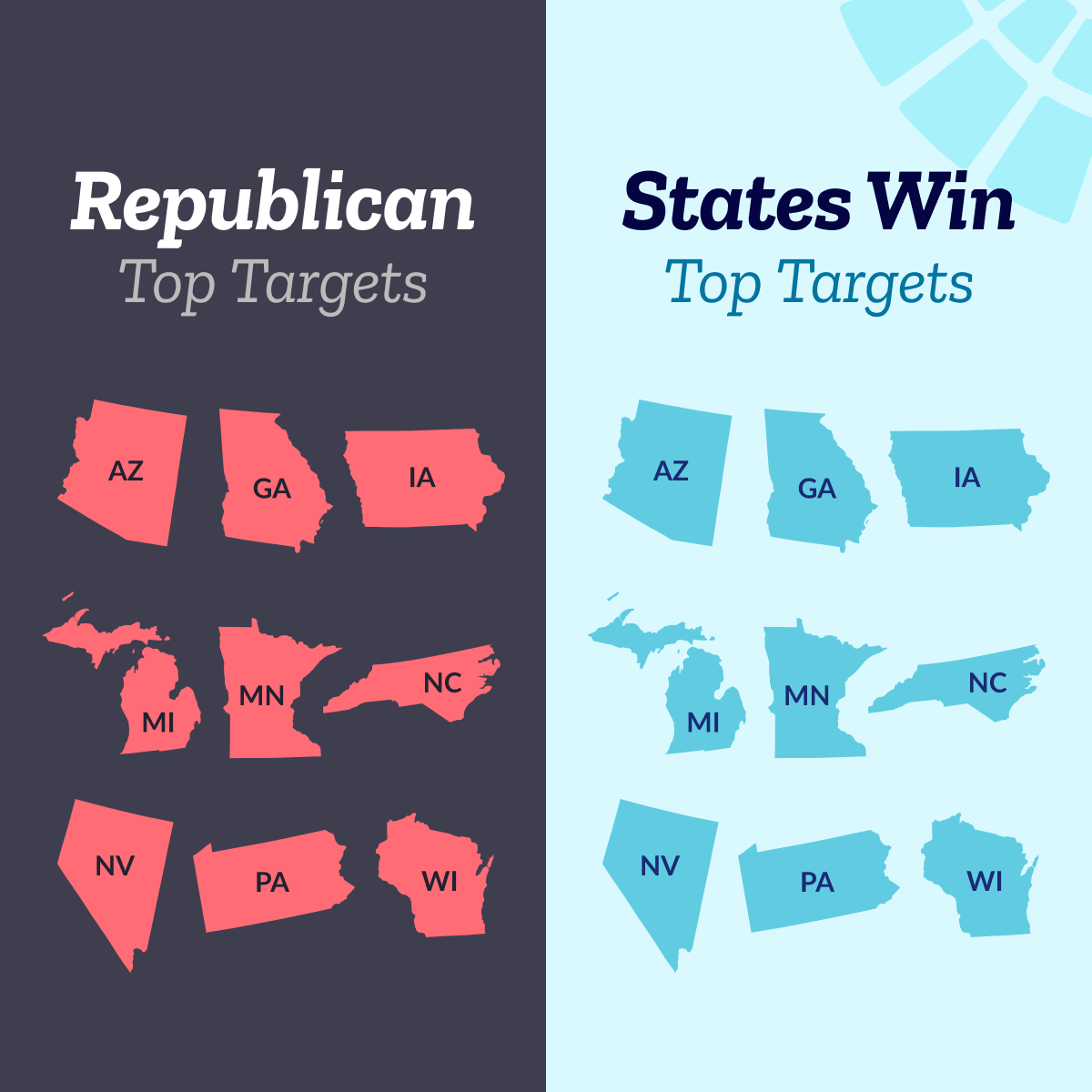
Nine states, in particular, are poised to define the balance of power in the midterms. These battlegrounds will determine whether Democrats can flip chambers, defend razor-thin majorities, break Republican supermajorities, and build governing power that lasts far beyond a single election cycle.
The stakes are so high that both States Win, which focuses on building long-term Democratic power in state legislatures, and the Republican State Leadership Committee (RSLC) are heavily targeting these states as central to the fight for power in 2026.
Republicans themselves have made clear just how much is on the line. In a recent memo, the RSLC warned:
“If Republicans lose even a handful of these seats, Democrats will gain the power to redraw congressional maps in multiple battleground states, locking in structural advantages that could last the rest of the decade and dramatically narrowing the path to a Republican House majority in Congress.”
If Democrats want to compete and win in 2026, these are the nine states that cannot be ignored.
Arizona
Once considered a reliable Republican stronghold, Arizona is now considered a true swing state, with Democrats flipping key statewide offices and presidential votes in recent years. Heading into the 2026 midterms, control of both the legislature and governorship is up for grabs. Flipping both the Arizona House and Senate is within reach, which would mean safeguarding reproductive freedom, climate action, and voting rights while being able to support the Democratic governor’s agenda. Democrats need to flip four seats in the Arizona House and three seats in the Arizona Senate to win control of both bodies.
Georgia
Another former red state that has become firmly purple, Georgia has opportunities for Democrats up and down the ballot in 2026. In addition to an open governor’s race and the re-election of Democratic Senator Jon Ossoff, all 180 seats in the Georgia legislature are up for election. Despite gerrymandered maps from the Republicans, in 2024, Georgia Democrats netted two additional seats in 2024, and hope to build on that momentum with a positive environment and a competitive election.
Iowa
Iowa is shaping up to be a major political battleground in 2026. There is an open governor’s race with a strong Democratic contender, an open U.S. Senate seat, and competitive House seats in play. If Democrats can sustain turnout and build on special election gains, they could transform what has historically been a red state into a critical battleground across races up and down the ticket.
Michigan
After Democrats secured a trifecta in 2022 for the first time in nearly 40 years, they wasted no time delivering major victories for working people and civil rights. In a state with deep labor roots, Michigan became the first state in nearly six decades to repeal so-called “right-to-work” laws, delivering a major win for unions and workers. Democrats also expanded protections for LGBTQ+ people, protected the fundamental right to an abortion after voters approved Prop 3, strengthened voting rights, passed common-sense gun safety laws, and invested in public schools and infrastructure.
Republicans took the state House back in 2024, which increased gridlock and slowed progress in Lansing due to the divided government. Democrats have an opportunity in November to hold or expand their razor-thin margin in the Senate, keep the governors’ mansion and then flip only three seats to win the Michigan House and secure a trifecta.
Minnesota
Minnesota Democrats secured a trifecta in 2022 for the first time in a decade, and used it to deliver historic victories including free breakfast and lunch for all public school students, protections for abortion access, expanded voting and worker rights, and making the state a refuge for trans people at a time when historic waves of anti-trans legislation were moving through Republican-led states . Currently, the DFL holds a narrow majority in the Senate and shares control of an evenly split House, margins that were both upheld by Democratic special election wins by States Win-endorsed candidates. In the midterm elections, Democrats will be working to protect our incumbents, take full control of the House, expand our majority in the state Senate and hold the governors’ mansion.
Nevada
While the state has a Republican governor, Democrats control the Nevada state House and Senate. Nevada is one of the few states in the country with a majority-women legislature, with Democratic women leading the way. With a competitive gubernatorial race, Democrats have a chance to not just win a trifecta but build a supermajority in the House to protect a Democratic governor’s veto or be able to overturn a Republican veto.
Pennsylvania
In this perennial battleground state, Democrats hold the state House and the governor’s mansion, but Republicans have the majority in the state Senate. In 2024, legislative Democrats out-performed the top of the ticket and held their one-seat majority in the state House, despite losing the U.S. Senate seat and the presidential vote. In 2026, with Trump’s approval reaching new lows and a popular Democratic governor running for re-election, Democrats have the chance to expand their majority in the House, flip the Senate and build a Democratic trifecta.
North Carolina
This state will be a defining battleground in the 2026 midterms, with control of the legislature and an open U.S. Senate seat on the line. Popular former Democratic Governor Roy Cooper is running for the U.S. Senate seat, bringing name recognition and attention to the top of the ticket. In 2024, Democrats ended the Republican supermajority in the House while holding the line in the Senate, preserving Democratic Governor Josh Stein’s ability to veto Republican attacks on reproductive rights, public schools, and voting access. Flipping vulnerable districts and defending key incumbents is the only way to keep Democrats strong enough to stop the GOP’s extreme agenda and build power.
Wisconsin
To understand what real political opportunity looks like heading into the 2026 midterms, Wisconsin is one of the best examples. After years of extreme Republican gerrymandering that locked in GOP control of the legislature, fairer maps went into effect in 2024. Democrats are now just two seats away from flipping the State Senate and five seats away from flipping the Assembly, putting Democratic legislative majorities within reach for the first time in over a decade. Winning in Wisconsin will not only determine the balance of power in Madison, but also shape the national political landscape in 2026.
At States Win, we’re proud to be the only national grassroots organization focused on winning state legislatures by directly supporting candidates and mobilizing a powerful volunteer network. Last year alone, our model helped secure a Democratic trifecta in Virginia, break Republican supermajorities in the Iowa and Mississippi Senates, and hold the line in Minnesota.
This year, we’re going toe-to-toe with the Republican State Leadership Committee and other major Republican groups as the fight for power in the states intensifies.
Our strategy starts with these nine battleground states that have become critical to winning power up and down the ballot and shaping the future of the country. To learn more and join our work, click here.
You’ve got North Carolina twice. Could you mean “South Carolina?” :-)
About PA, you explain: "Democrats have the chance to expand their majority in the House, flip the Senate and build a Democratic trifecta." Then shouldn't the PA (Senate) be categorized under "Blue Flips" and PA (House) under "Blue Inroads" on https://stateswin.org/our-approach/electoral-strategy-deep-dive/ ?